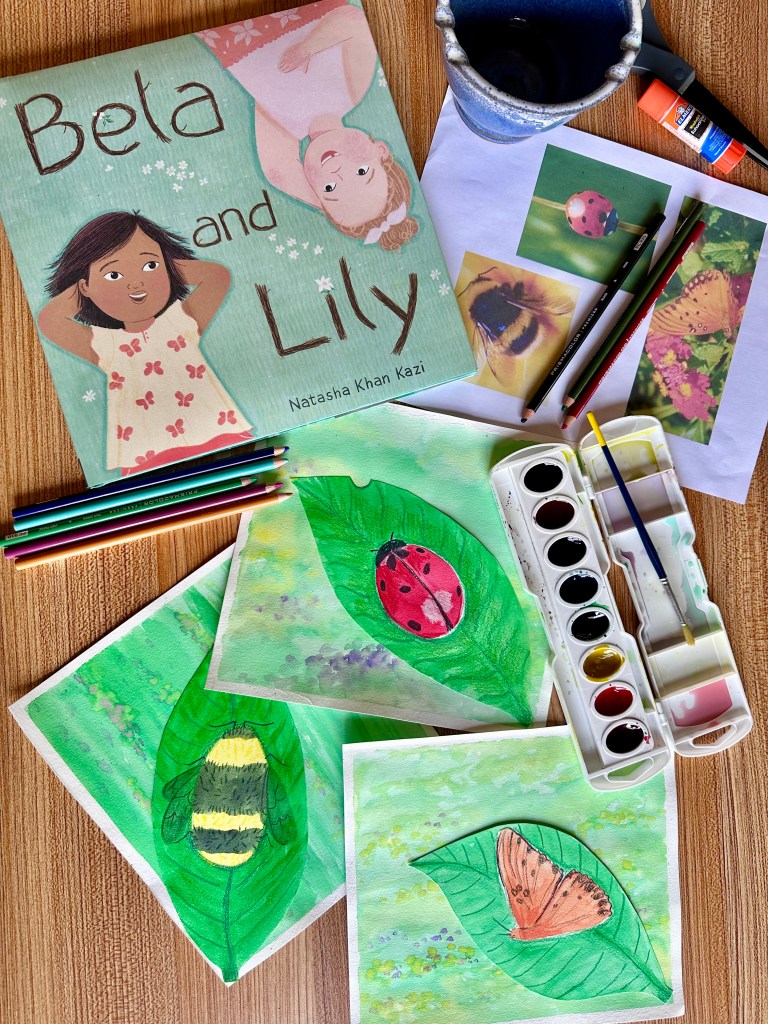
One of the most important skills artists develop is learning how to see. When children first begin drawing, they often believe every part of a picture deserves the same amount of attention. Every flower needs petals. Every blade of grass needs details. Every leaf should look exactly the same. But artists learn something different. Some things are meant to be seen up close. Other things are meant to be felt rather than carefully described.
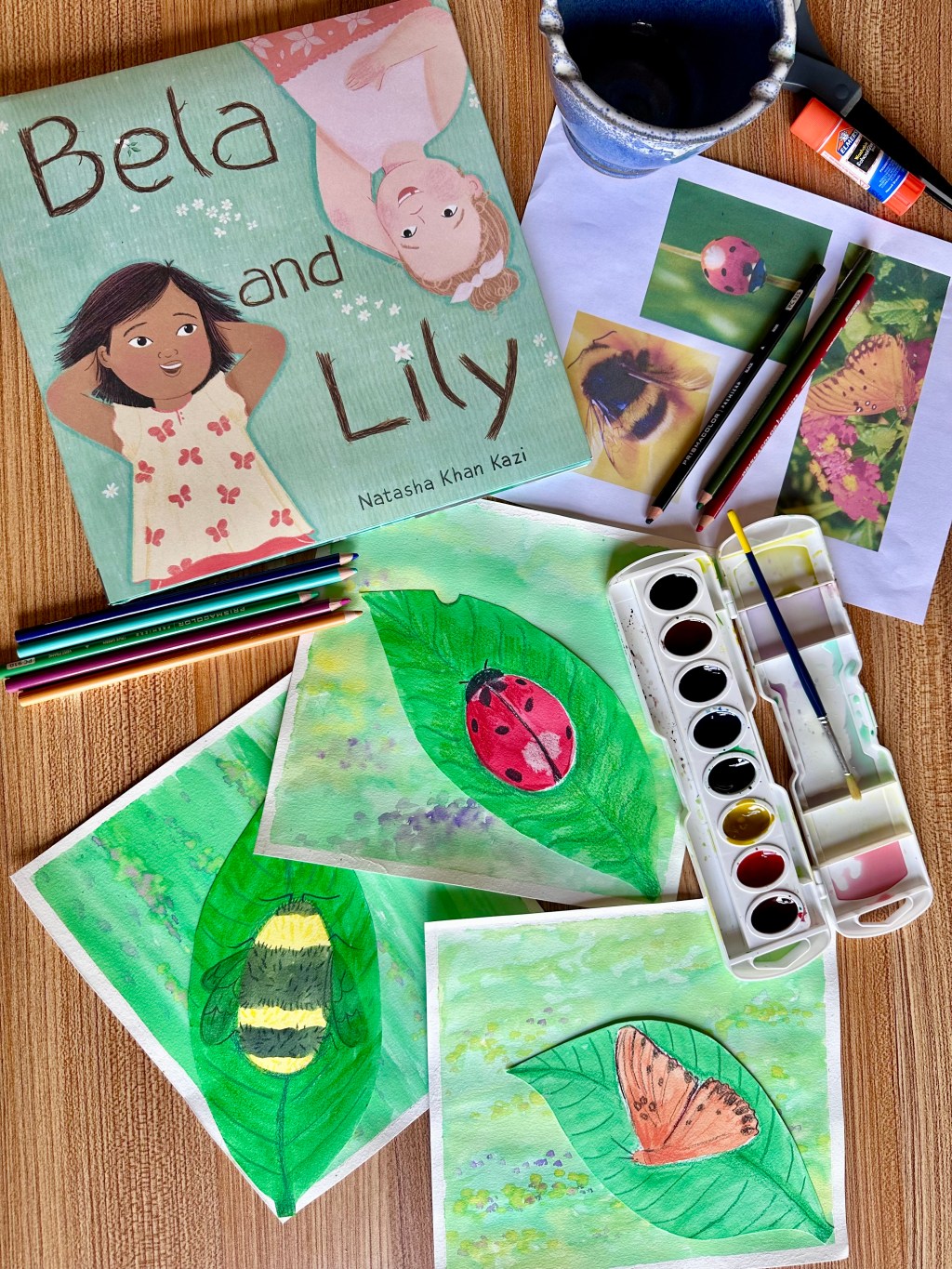
In this watercolor collage inspired by my picture book Bela and Lily, students explore both ways of seeing as they create a colorful pollinator resting on a leaf.
But First, Shopping
I’m not going to lie, shopping for art supplies is one of my favorite parts of beginning a new project. My favorite art supply store is BLICK. Their quality is very consistent, especially for student-grade products.
- Prang Watercolor Paint
- Canson XL 9 x 12 Mixed Media Paper
- Prismacolor Premier Colored Pencil Set, 36
- Scissors (for older elementary, I like Fiskar’s Big Kid Scissors)
- Prismacolor Pencil Sharpener (I hand-sharpen my colored pencils to not over-sharpen.)
- Drawing Pencil (A great collection of drawing pencils from Blick Studio)
- Eraser (This eraser set is so fancy)
- Elmer’s Glue Stick
In full disclosure, the links above are affiliate links. Shopping from my supply list will help me generate income and continue creating free projects.
Video Tutorial
Scroll to the bottom for the free printable art lesson and the pollinator reference handout!
Learning About Watercolor Washes
One of my favorite parts of this lesson is that students are introduced to watercolor washes in a simple and approachable way. A wash is watercolor paint mixed with water, but not all washes are the same. Some washes contain more pigment, creating richer, more vibrant color. Others contain more water and create lighter, softer effects.
Teacher Tip: If you’re short on time or teaching younger students, liquid watercolors can speed up the process considerably. They create vibrant color, require less mixing, and tend to dry more quickly than heavily applied pan watercolors. Plus, Prang Semi-Moist Watercolors need to be diluted into a proper wash, or they dry sticky! Making it difficult to color on them with colored pencils.
The Art of Observation
Once the paint has dried, students use colored pencils to add details to their pollinator and leaf. This is where observation becomes important. When students look closely at a ladybug reference, they quickly discover that a ladybug is not simply a red oval with black dots. The spots are often irregular. Highlights reflect off the shiny shell. Shadows create depth. Tiny details appear that they might have missed at first glance. Meanwhile, the background remains loose and soft. The result is a composition that teaches an important artistic principle: nearby objects often contain more visible detail than distant ones.
More Than an Art Lesson
What I love most about this project is the connection to the themes of Bela and Lily. The story is about friendship across a language barrier. At first, communication feels uncertain. Understanding is incomplete. The characters only see part of the picture. As they spend time together, things become clearer. Art often works the same way.
When we first look at something, we may only notice the general impression. But when we slow down and truly observe, details begin to emerge. We see colors we missed before. Patterns we overlooked. Small moments of beauty that were there all along. Whether we are studying a ladybug, learning a new language, or making a new friend, understanding grows when we take the time to look closely.
Download Art Lesson
Happy painting,
Miss Natasha


![[Free Printable] Squiggle Art Drawing Prompt: A Fun Creativity Exercise](https://artwithmissnatasha.com/wp-content/uploads/2025/04/img_1699.jpeg?w=1024)
![[Free Printable] Celebrate Dr. Martin Luther King Jr. Day Coloring Sheet](https://artwithmissnatasha.com/wp-content/uploads/2025/01/img_8638.jpeg?w=1024)
 Art with Miss Natasha
Leave a comment